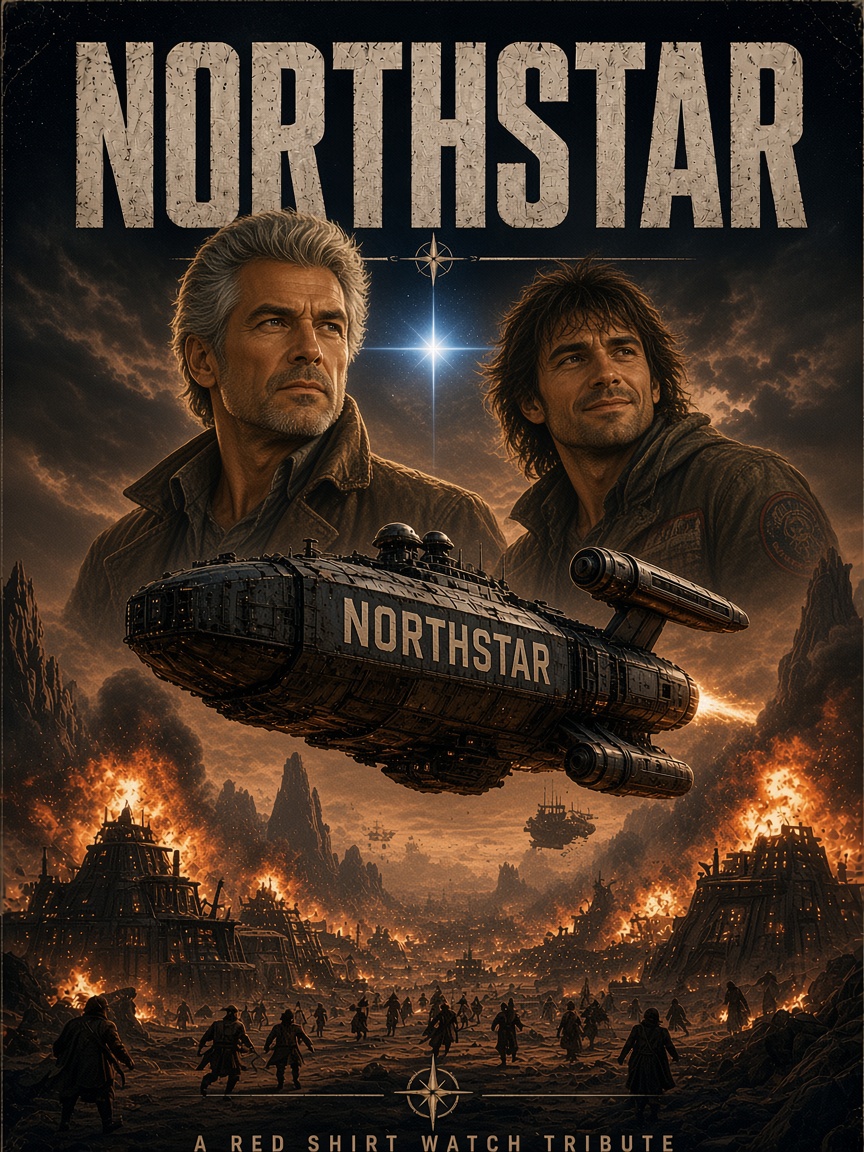
A standalone story. 2372. The Klingon border.
The Bucket was running dark, and she did not like it.
Nobody aboard had ever asked her. She was a J-class hull, Earth Cargo Service, laid down in a Jupiter Station yard eight years before the Romulans came, and she had hauled ore and grain and the occasional coffin through two centuries of other people's history. Somewhere along the way somebody had bolted a newer warp core into her spine, and somebody else had hung a pair of salvaged nacelles off her flanks like saddlebags, and a third somebody, a Tellarite with opinions, had rewired her sensors in a way that made sense only to Tellarites. The name on her bow, under three coats of paint and one of carbon scoring, was NORTHSTAR. Nobody had called her that in years.
With her running lights off and her emissions down to a whisper, the Bucket groaned. Her deck plates ticked as they cooled. A ventilation duct somewhere aft had developed a sound like a man humming through his teeth. The air on the flight deck smelled of hot dust, old coffee, and the lemon solvent Sergei used on the consoles and swore was the only thing keeping them alive.
Outside the forward port, the debris field turned slowly in the starlight.
It had been a convoy once, three weeks ago. Now it was a cloud of hull fragments and frozen coolant and things that tumbled end over end and caught the light and were gone. Some of the pieces were Federation gray. Some were Klingon green. Out here it was getting hard to tell the difference.
"Proximity," the computer said, in a voice like a disappointed aunt.
"Yes, yes," said Sergei. "I see it."
He did not look at the display. He was leaning forward in the pilot's chair with his elbows loose and his hands light on the controls, the way a man holds a bird he does not want to crush. He was a compact man somewhere in his forties, dark-haired, with a face that had been handsome and was now merely interesting, and a scar through one eyebrow that he told a different story about every time somebody asked. His lips moved as he flew. He was counting.
A slab of something the size of a shuttlecraft rolled past the port, close enough that the Captain could have read the serial numbers on it if he had been looking.
He was not looking. He was sitting in the second chair, the one with the cracked armrest, with his boots up on the edge of the engineering console and a padd in his lap and an expression of profound disinterest.
"Proximity," said the computer again.
"She worries," Sergei said. "Like my mother."
"Your mother," said the Captain, without looking up, "would have turned around an hour ago."
"My mother would have flown through it faster." Sergei eased the yoke a hair to port. The Bucket rolled, ponderous and unwilling, and something long and twisted went sliding by underneath them with a sound, through the hull, like a fingernail drawn very slowly down a blackboard.
The Captain turned a page on his padd that did not need turning.
He was older than Sergei by a good margin, though he carried it the way some men carry a good coat. He was lean and straight-backed, with a full head of hair gone the color of iron, cropped short, and a face built of hard angles that had spent a long time deciding not to show anything. He wore a brown leather jacket so old it had gone soft as cloth at the elbows, and a phaser low on his right hip in a holster that had been made for something else. When he stood up, which he did not do now, he had a habit of tugging the jacket straight at the hem, sharply, as though it had personally offended him.
"Sensors," he said.
"Sensors are, how do you say. Ornamental." Sergei tapped the display, which showed a grainy smear of green. "The Tellarite. Every time I open that panel I find a new note. In Tellarite. I think they are insults."
"They are insults."
"You read Tellarite?"
"I read Tellarites." The Captain set the padd down. "How long?"
"To the edge? Six minutes. If nothing moves." Sergei's eyes flicked up, and for an instant his hands went still, and then he pushed the yoke forward and down, and the Bucket dropped like a dropped plate. The Captain's boots came off the console. Something enormous and dark, a warp nacelle, one end shorn away, slid across the top of the port where their heads had just been, and was gone.
"Something moved," Sergei said.
The Captain looked at the space where the nacelle had been. Then he put his boots back on the console. "Six minutes," he said.
"Five and a half. I am very good."
"You are adequate."
"I am the best pilot on this ship."
"You are the only pilot on this ship."
"So," said Sergei, with enormous satisfaction, "the best."
Behind the flight deck, the Bucket opened up into a corridor that had been built for a crew of twelve.
There were eight bunks off it, four to a side, in narrow rooms with sliding doors. Six of them had their doors shut and their mattresses rolled and strapped. One had belonged, for about four months last year, to a Bajoran cargo master named Teral who had laughed at everything and left at Kessick Station with half the ship's coffee and a sincere apology note. One had belonged, a long time before that, to somebody the Captain did not talk about. The galley had a table for ten. They used two chairs. The other eight had become shelves.
The cargo hold took up the back half of the ship, and it was cold. The Captain kept it that way on purpose. Forty sealed crates sat in the middle of the deck in four neat rows, strapped down with magnetic ties, each one marked with the blue caduceus of the Tessaly Pharmaceutical Exchange and a smaller, less official symbol somebody had stenciled underneath in yellow.
Inside each crate, in a cradle of gel, were two hundred ampoules of a pale, faintly luminous liquid that looked like moonlight somebody had poured into glass.
Its name was selvine. It came from a lichen that grew on exactly one moon in the Tessaly system, in the shadows of exactly one range of mountains, and nowhere else anyone had found in two hundred years of looking. It could not be replicated; the molecule was folded in a way that replicators tended to get almost right, and almost right, with selvine, would stop a heart. Rendered and stabilized, it was the only reliable treatment for half a dozen fevers that liked to burn through the blood of warm-bodied species, Klingons among them.
It was also, to an Orion, roughly what a very good night was to a human. Orions put it in their wine. Ferengi paid triple for it and then sold it to Orions. On certain Rigelian pleasure worlds it went for its weight in latinum, and then some.
None of this was illegal. The Federation had looked very hard, more than once, for a way to make it illegal, and found none that would not also make it impossible for a doctor to get it. So it was legal. It was simply the kind of legal that made Starfleet officers go a little stiff around the mouth when you mentioned it, and made port authorities search your ship twice, and made a certain kind of person very rich.
Forty crates. The Captain had done the arithmetic many times. Forty crates of selvine was worth a little more than the Bucket, the Bucket's next three refits, and the Captain's own life insurance, if he had had any.
He went down to look at them sometimes. He did it now, after they cleared the debris field, standing in the doorway with his hands in his jacket pockets and the cold coming off the deck through his boots. Then he went back up front.
The broker called at 0300 ship's time, which was the broker's idea of courtesy.
His face filled the small screen in the galley: blue, round, cheerful, with the faint ridge down the middle that every Bolian had and that Sergei privately thought made them look like very friendly loaves of bread. His name was Pell. Behind him, through a window, the docking ring of Tessaly Station hung against a fat orange gas giant.
"My favorite captain," Pell said.
"I'm your only captain who isn't in jail."
"That is also true! You are on schedule?"
"We're on schedule."
"The war has not disturbed you?"
"The war," said the Captain, "has disturbed everybody, Mister Pell. We're on schedule."
"Wonderful. Wonderful." Pell leaned back. "I have buyers lined up. Two hospitals on Rigel Four, a clinic consortium at Bolarus, a very nice man from the Ktarian medical authority who wishes to remain anonymous and will be paying in advance." He beamed. "Most of it, as always, to people with white coats."
"And the rest?"
"The rest," said Pell, "to people with very nice coats. It is a free galaxy, Captain."
"It's a free galaxy for people who pay their invoices." The Captain sipped from his mug, made a face at it, and set it down. "The price we discussed."
"Is the price we discussed."
"Plus the war."
Pell's smile did not change, but his eyes did. "Plus the war?"
"There's a war on, Mister Pell. I flew through what's left of a convoy to get to you. You'll have noticed that selvine has gone up fourteen percent on the Ferengi exchange since the Klingons tore up the Accords. I'd like to be paid in the currency of the galaxy we're currently living in."
"Eight percent."
"Twelve."
"Ten, and I don't tell the station master what is stenciled underneath my caduceus."
The Captain considered this. "Ten," he said.
"I love doing business with you," said Pell. "Always so civilized." He put a fingertip to his screen. "Seventy hours. Do not be late, my friend. Your hospitals are waiting."
The screen went dark.
Sergei had been leaning in the galley doorway, eating something out of a bowl with a spoon. "Ten percent," he said.
"Ten percent."
"You wanted ten."
"I wanted ten."
"You asked for twelve so he would say ten."
"I asked for twelve," said the Captain, "so he would feel he had won something. A man who feels he's won something pays on time." He looked at his mug again. "What is this?"
"Tea."
"It isn't."
"It is the replicator's best idea of tea."
"Then the replicator," said the Captain, "has never met a tea." He poured it into the reclamation slot and stood there for a moment looking at the slot with a kind of personal grievance. Then he tugged the jacket straight and went forward.
Sergei watched him go, and finished his bowl, and said to nobody, "My great-grandmother made tea in a samovar that was older than this ship. Real tea. Russian. You know what the samovar is? It is a Russian invention."
The ship hummed through its teeth.
"Also tea," said Sergei, "is basically Russian. The Chinese only got there first."
The Bucket had a subspace receiver that was better than it had any business being.
It was the one piece of equipment aboard that the Captain maintained himself. He did not let the Tellarite touch it, and he did not let Sergei touch it, and when Sergei had once asked where a civilian freighter got a Starfleet-pattern decryption buffer, the Captain had said, "A card game," in a tone that closed the subject and welded it shut. It could not read anything classified. But Starfleet, in wartime, said a great many things that were not classified, and said them loudly, on the theory that civilians in the war zone ought to know where not to be.
The Captain listened to it the way some men listen to the weather.
They were eleven hours out of the debris field, cruising at warp four through a stretch of nothing, when it started talking.
It was an open fleet advisory, the kind that went out in plain voice on a loop. A woman's voice, tired, precise. Sergei was asleep in the pilot's chair with his feet on the console and his mouth open. The Captain was in the other chair, mending the strap of his holster with a needle and waxed thread, and he did not look up at first.
"...all civilian traffic in the Tarsk sector. Federation medical transport USS Seacole was engaged by unidentified vessels at 1340 hours, coordinates following. Repeat, unidentified vessels. Not, repeat not, Klingon Defense Force. Raider configuration. The Seacole sustained heavy damage and has withdrawn toward Starbase Two-Twelve. Civilian vessels are advised to avoid the Tarsk sector until further notice."
The needle stopped.
The loop went around again. The Captain listened to it all the way through a second time. Then he set the holster down on the console, and reached over, and began working the receiver, quietly, one hand, the way a man feels for a light switch in a house he grew up in.
He found the medical net. Then the convoy net. Then a relay chatter channel where two Starfleet operators at two starbases were talking to each other about logistics with the voices of people who had not slept in a week.
It took him perhaps twenty minutes to put it together.
The Seacole was a hospital ship, Olympic-class, a big white bubble of a thing with more sickbays than phasers. She had been sent across the line under a flag of truce with a full hold of selvine and a medical team, to a place called New Kronos. New Kronos was a Klingon colony. Not a military one: a farming colony, eleven hundred civilians on the fourth planet of a red dwarf just inside the territory the Klingons had claimed when they tore up the treaty. Two months ago something the Starfleet operators called Serrin's syndrome and the Klingons called by a word that meant the blood-fire had gotten loose in it. The Klingon Empire, which was busy, had not sent anyone. A Federation hospital ship had been on her way to them for no better reason than that they were sick and there were children there.
She had been eight hours out when the raiders hit her.
"Command says no," one of the operators said, on the relay. She sounded young. "There's nothing to send. Every hull in the sector is on the line. They'll try again in three weeks, if the front holds."
"Three weeks," said the other operator.
"I know."
"Their doctor sent the numbers. They don't have three weeks. They don't have one."
There was a pause on the relay, full of static and fatigue.
"I know," said the young one again. "They've told the colony."
The Captain turned the receiver off.
The flight deck went very quiet. The ventilation duct hummed. Sergei snored, once, and settled. Outside, the stars went by in long, pale streaks, the way stars do at warp, and the Captain sat with his hands flat on his knees and looked at them for a long time without seeing them at all.
He was nine years old, and it had rained all night.
He woke before dawn in the room at the top of the house, under the slanting ceiling with its old dark beams, and he knew something was wrong before he knew anything else. The house was too quiet. In summer the house was never quiet. It was his great-aunt's house, the big one, the old stone one in the valley, and his mother sent him there every summer from Lyon so that he would, as she put it, learn what his grandfather's people were made of. It was full, always, of cousins and dogs and the clank of the kitchen and his great-aunt's voice, which could be heard from the bottom of the lower field.
That morning there was nothing. Only water, dripping off the eaves.
He went down the stairs in his bare feet. The kitchen was empty, and the big table was empty, the scrubbed oak one where there was never, ever a replicator, because his great-uncle said that a meal you had not made with your hands was a meal you had not earned. The back door stood open. Through it came the smell he would know for the rest of his life, anywhere, on any world: wet earth and crushed leaves and the sweet, heavy, almost rotten scent of grapes on the vine a week from harvest.
Everyone was in the lower field.
He came down through the rows in the gray light with mud to his ankles, and he saw his great-uncle first, standing at the end of a row with his cap in his hands. He was a tall old man with a bald, brown head and big, ruined, careful hands, and he was looking across the stone wall at the next vineyard over. The neighbors'. The Bouvier land.
It had hailed in the night. Not on them; it had missed them by a hundred meters, the way hail does. It had come down on the Bouviers instead, out of a black sky, stones the size of a boy's thumb, and it had stripped the vines. From where he stood he could see it: whole rows of leaves shredded to green lace, clusters burst open, purple juice running into the mud. Old Bouvier was standing in the middle of it in his nightshirt with his hands at his sides.
"What will they do?" he asked.
His great-uncle did not look down at him. "Whatever can be saved has to come in today," he said. "Before the rot gets into the broken fruit. By tonight it will be too late."
"But our grapes..."
"Will wait a day."
"Will they?"
His great-uncle did look down at him then. He had pale, steady eyes, and a way of looking at you as though you had already disappointed him and he was giving you one chance to change his mind.
"Some of them won't," he said. "We'll lose some. The rain will split a few." He put his cap back on. "Go and get your boots. And tell your cousins I want every basket in the barn."
The boy stood there. He was nine, and he had been promised the harvest, his first real one, with a knife of his own. He knew exactly what a day lost cost a vineyard. Everyone in that valley knew. You did not leave your own fruit on the vine a week from harvest after a night of rain. You did not.
"They didn't ask us," he said.
His great-uncle had already started walking toward the wall. He stopped, and turned around, and the look on his face was not anger. It was something worse, from a man like that: it was surprise.
"Why," he said, "would they have to?"
That was all. He didn't explain it. He went over the wall, an old man in his sixties, one hand on the stones, and walked into the ruin of the Bouvier vines and put his hand on old Bouvier's shoulder. And by the time the sun was full up there were eleven people from the house in that field, and the dogs, and the boy among them in his boots with his knife, cutting split clusters into a basket with purple to his elbows and the hail still lying unmelted in the furrows like spilled pearls.
They saved about half of the Bouvier harvest. The rain split a fifth of their own.
At supper that night the big oak table was full and loud, and there was a bottle open from a year before he was born, and his great-uncle poured him a finger of it in the bottom of a glass, which his mother would never have allowed, and said, without looking at him: "Now you know."
He hadn't known what he was supposed to know. He'd thought about it for years. In the end he'd decided that there wasn't anything more to it than that. There was a wall. On one side were your vines, and on the other side were somebody else's, and when the hail came there was not, there had never been, any question of which side you were on.
"Captain."
He looked up. The stars were still streaking by. His hands were still flat on his knees.
Sergei was awake. He had taken his feet off the console, and he was sitting very straight in the pilot's chair, looking at the navigation display, and then at the Captain, and then at the display again.
"Captain," he said, "the heading."
The Captain looked at the display.
"What about it?"
"We are not going to Tessaly."
"No?"
"No." Sergei turned the display toward him, as though he might not have seen it. The little green line of their course, which had run straight and true toward Tessaly Station since the debris field, now bent. It bent hard, about forty degrees to starboard, toward the border, toward a scatter of red-dwarf stars on the far side of a line the chart had drawn in angry orange. "We are going to the Tarsk sector. We are going," said Sergei, peering, "to the Tarsk sector at warp six, which this ship does not do."
"She does it," said the Captain. "She complains."
"The log says the course was changed by your code. Twenty-two minutes ago." Sergei looked at him. "Twenty-two minutes ago you were listening to the radio."
The Captain picked up his holster and his needle and went back to work on the strap. "Was I."
"You were."
"Then I must have been listening to it very carefully."
Sergei opened his mouth, and closed it, and looked out of the port at the stars, which were indeed streaking past faster than he was used to, and listened to the Bucket, which was indeed complaining: a deep, low thrum in the frame that he could feel through the soles of his feet, like a big animal working uphill.
"New Kronos," he said.
"Hm."
"It is a Klingon colony."
"So I'm told."
"We are at war with the Klingons."
"The Federation is at war with the Klingons." The Captain drew the thread tight and bit it off. "I'm a private businessman."
"Captain." Sergei leaned forward. "Forty crates. Seventy hours. Mister Pell. Ten percent. Plus the war." He was counting on his fingers. "If we do not deliver, Mister Pell will not pay. If Mister Pell does not pay, we cannot pay. The fuel. The dock fees at Tessaly. The Tellarite. You still owe the Tellarite for the sensors."
"The sensors are ornamental. He can have them back."
"There is a war! There are pirates, there are Klingons, there are... we do not even know who shot the hospital ship. A hospital ship, Captain. If they shoot a hospital ship, what do they do to the Bucket?"
"Nothing very much," said the Captain. "Not if you fly her properly."
Sergei stared at him.
The Captain held the holster up to the light, looked at the stitching, decided it would do, and buckled it back on. Then he stood up, and tugged his jacket straight, and went over to the galley hatch.
"I am going to do some arithmetic," he announced, to nobody in particular. "Because one of us has to be practical about this."
He did. He sat at the galley table, at one of the two chairs, with a padd. He did it for nearly an hour, muttering. Sergei could hear him through the hatch. He did the fuel. He did the price of selvine on the Ferengi exchange, and on the Orion one. He did what forty crates would fetch at Tessaly and what they would fetch at Rigel and what they would fetch if he took them to a man he knew on Farius Prime and asked no questions about where they went. He did the cost of a new deflector grid, and of the Tellarite, and of a month's dock fees, and of a year's. He did what the Bucket would sell for if they had to sell her, and said a word in French about the number that Sergei did not need translated. He did all of it very thoroughly, out loud, with every sign of a man trying to talk himself out of something.
At no point did he get up and change the course back.
At no point, Sergei noticed, did he even look toward the flight deck.
Sergei sat in the pilot's chair and listened to the muttering and to the Bucket grinding along at a speed she had last done willingly before he was born, and after a while he began to smile. He didn't mean to. He turned his face toward the port so that it wouldn't show. And then, because his hands needed something to do, he pulled up the long-range charts of the Tarsk sector and began, carefully and with great interest, to look for a way in.
Pell called back at 0600. The Captain took it on the flight deck.
"I have been looking at your transponder," said the Bolian, "out of friendly concern. You appear to be going in the wrong direction, my friend."
"I'm taking the scenic route."
"Through the Tarsk sector."
"It's very scenic."
Pell's round blue face did something unhappy. "Captain. I have heard the advisory. I have friends on Starbase Two-Twelve. I know what you are thinking. I want you to know that I, too, have a heart." He placed a hand on his chest, in approximately the right place for a Bolian. "It is a very nice heart. It has always been sympathetic. But I also have a hospital on Rigel Four who has paid me in advance."
"Then you'll be able to give it back."
"Captain."
"I'll be honest with you, Mister Pell," said the Captain, and Sergei, who had been at the controls, felt his ears go up, because in four years he had never once heard the Captain say those words to anybody who was going to like what came after. "I'm not going to make your delivery. Not this month. I'm sorry for the inconvenience. I'll cover your penalty to the Rigellians out of my own pocket, when I have a pocket again. And you can tell your station master anything you like about what's stenciled under your caduceus."
Pell looked at him for a long moment. There was a great deal going on behind the small, cheerful eyes, most of it arithmetic.
"You know what they will be doing, out there," he said at last, quietly. "The ones who shot the Seacole. You know why they did it."
"I can guess."
"They are not going to let you through. A dying colony is the best market in the galaxy. They charge what they like. Children," said Pell, with real distaste, "are very good for prices."
"I'd heard."
The Bolian sighed. It was a long sigh; Bolians had a lot of lung.
"I am going to tell the Rigellians," he said, "that your ship suffered an act of God."
"That's very generous."
"It is not generous. It is a lie. God has nothing to do with it." Pell reached for his controls, then stopped. "Captain. Do not get killed. You are the only one who pays his invoices." He thought. "Mostly."
The screen went dark.
They came out of warp at the edge of the Tarsk sector nineteen hours later, and the pirates found them inside of an hour.
Sergei saw it first, a pale smudge on the ornamental sensors that the ornamental sensors were clearly not sure about, and then the long-range scanner, the one that worked, put a shape to it. A long, narrow, dark hull, like a knife with the handle broken off. Big. Three times the Bucket's mass. A raider, built in some yard that did not keep records, out of pieces from four or five other ships. Its weapon ports were open.
"Here," said Sergei softly. "Here is our friend."
The comm chimed before he had finished saying it.
The Captain let it chime three times. Then he put it on screen.
The man on the other side was human, or mostly. He was slight and neat and middle-aged, with thinning sandy hair and wire-rimmed spectacles of the kind nobody had needed in three hundred years and some people wore anyway, and he had a soft, reasonable voice, like a schoolmaster's. Behind him the raider's bridge was dim and red and full of the silhouettes of people who did not have soft voices. A Nausicaan. Two Orions. Something big and gray that Sergei could not identify and did not want to.
"Captain," said the man. "My name is Varran. I'm told you have something of mine."
"You've been misinformed. Everything on this ship is mine. Including," said the Captain, "the debt."
Varran smiled. It was a nice smile. "Forty crates of selvine, out of Tessaly. Contracted to the Bolian, Pell. Bound, as of last night, for a farming colony on the far side of the line." He took the spectacles off and polished them on a cloth. "News travels, out here. Particularly from Bolians."
"Mister Pell has a big heart."
"Mister Pell has a big mouth. It comes to the same thing." Varran put the spectacles back on. "I'm going to be direct with you, Captain, since we're both businessmen. I've invested a great deal of effort in New Kronos. It is, at present, the single most profitable square kilometer in this quadrant, and I would like it to stay that way for at least the next three weeks. After that the Klingons may get around to it, or Starfleet may, and I shall move on. But in the meantime I can't have a man flooding my market with forty crates of free medicine. You see the problem."
"I see a problem."
"So here is what I propose." Varran spread his hands. "You stop where you are. You drop your shields, which I'm told are not very good. I send a boat across. I take the crates. And I pay you for them. Pell's price." He paused. "Plus the war."
Sergei looked at the Captain.
The Captain looked at Varran with an expression of mild, academic interest, like a man examining a horse he didn't intend to buy.
"Pell's price," he said, "was a Tessaly price. You're going to sell to New Kronos. I'm told the New Kronos price is rather better."
Varran's smile widened by a millimeter. "Twice Pell's price."
"I'd want three."
"I'd want world peace, Captain. Two and a half."
"Three. And your boat doesn't come across. I'll put the crates in a cargo pod and leave them for you, and you can collect them when we're a long way off. I'm an old man and I've had a bad week, and I don't like strangers on my ship."
"Three," said Varran slowly, "and you leave the pod."
"Three," agreed the Captain, "and I leave the pod."
There was a pause.
"Then we have a deal," said Varran.
"No," said the Captain, "we don't."
Varran's face did not change. Behind him, the Nausicaan shifted.
"I just wanted to know what it was worth to you," said the Captain. "Now I know. You'd pay three times the price of forty crates to keep eleven hundred people sick for three more weeks. That tells me everything I need to know about you, Mister Varran, and nothing I didn't suspect." He leaned forward a little. "So I'll make you a counteroffer. You turn that ship around. You go back to whatever hole you came out of. And I'll forget I ever saw your face. That's the price. It's the only one you're getting."
Varran looked at him for a long, long moment.
"You're a sentimental man, Captain," he said at last. "It's going to be very expensive for you."
"It's always been expensive," said the Captain. "I find it's worth the money."
He cut the channel.
The flight deck was very quiet.
"So," said Sergei. "That was haggling?"
"That was haggling."
"You do not get the money."
"I didn't want the money. I wanted his attention." The Captain sat back in the cracked chair and put both hands on the armrests. "How far to New Kronos?"
"Four hours at warp. But he is between us and it." Sergei's fingers were already moving on the board. "And he is faster. And he has more guns. And he will be shooting at us, very soon now, I think. Captain, he is much bigger than us."
"Yes," said the Captain. "Isn't he."
And for the first time on the whole voyage, he smiled.
The first shot missed them by forty meters, and the Bucket rang like a church bell anyway.
It was a disruptor bolt, green and ugly, and it went past the starboard nacelle close enough that the shield flared blue across the port and the whole frame shuddered and every loose thing on the flight deck jumped a centimeter to the left. A padd skittered off the console. The ventilation duct stopped humming, thought about it, and started again in a higher key.
"Warning shot," said the Captain.
"That was not a warning shot."
"It missed."
"I missed it," said Sergei. "He was not trying to miss."
He had both hands on the yoke now, and his shoulders had come up, and his face had gone very calm in the way it only did when things were very bad. The Captain had seen it twice before. Once had been an ion storm off Gamma Hromi. The other time they didn't talk about.
"Can we outrun him?"
"No."
"Can we outfight him?"
"With what? Harsh language?" The Bucket had a single phaser emitter under her chin that the Captain had bought from a Ferengi who swore it had been fitted to a Starfleet runabout, and it had once, in a tense moment at Farius, very nearly frightened a Yridian. "No. We cannot outrun him and we cannot outfight him. So we will not do either." Sergei's eyes were on the long-range chart. "Captain. Tell me about this star."
The Captain glanced at it. "Red dwarf. Old. Flare star, according to the chart. There's a debris disk."
"Big debris disk," said Sergei. "Very big. Very messy. All the way in, almost to the fourth planet. Comets, rocks, ice. You do not fly in this; you go around it, you come in from the pole. Everybody comes in from the pole. The Seacole came in from the pole, I think, and that is where they were waiting." He took a breath. "We will not come in from the pole."
The Captain looked at the chart. Then at Sergei.
"You want to fly through that."
"I want to fly through that at warp," said Sergei. "Then drop out inside it. Inside, he cannot follow us at warp; he is too big, his field is too big, he will hit something. He will have to come in on impulse, slowly, carefully, through all those rocks. And we," he said, "will already be there."
"Nobody drops out of warp inside a debris disk."
"No," agreed Sergei. "This is why he will not expect it."
The second shot hit them.
It took them on the port quarter, aft, and the Bucket lurched as though something had grabbed her by the tail and shaken her. The lights went red. Somewhere behind them, in the corridor with the empty bunks, a panel blew out with a flat, hard bang, and the air was suddenly full of the smell of scorched insulation and hot metal. An alarm started, the old Earth Cargo Service alarm, a two-tone honk that had been designed in the 2140s by somebody who believed fear was a useful motivator.
"Port shield's at thirty percent," said the Captain, at the engineering board, in the same voice he'd used to order tea.
"Then do not let him hit the port side."
"I wasn't planning to."
"Captain." Sergei did not look away from the port. His hands were moving. "I need everything. Everything the core will give. I need the inertial dampers at maximum, because otherwise when we drop out of warp in there you and I will be a stain on the windows. And I need you to not argue with me for maybe ninety seconds."
The Captain looked at him. Then he turned to the engineering board and began, very fast, to take power away from things. Life support aft. The galley. The hold heaters; the cold in the hold would hold the selvine for a day. The empty bunks. The ornamental sensors, with a certain satisfaction.
"You have it," he said.
"Thank you." Sergei reached up and, without looking, flipped the cover off a switch that had a strip of yellow tape across it on which someone, long ago, had written NO in English, Tellarite, and Bolian. "Hold on, please."
The Bucket went to warp seven.
She had never done it. The Captain was fairly sure she had never been asked. The thrum in her frame went up through a groan into a sound like a man screaming through a pipe, and the deck under his boots began to vibrate so hard his teeth hurt, and on the board a dozen tiny lights went from green to amber and from amber to red and stayed there. The stars outside stretched into white wires. Behind them the raider's next shot went wide, because they were not where it had been aimed.
And then they were in the disk.
There was no way to see it at warp. There was no way to see anything. There was only the chart, which was fourteen years old, and the sensors, which were Tellarite, and Sergei, who sat absolutely still in the pilot's chair with his lips moving, counting again, in Russian now, and making tiny, tiny corrections with the tips of his fingers. Something hit the forward shield and flashed white and was gone. Something else. The Bucket shuddered, and shuddered, and kept going.
"Odin," Sergei whispered. "Dva. Tri."
He pulled the yoke back.
They came out of warp like a rock coming out of a sling.
The dampers took most of it. They did not take all of it. The Captain was thrown sideways into the engineering console hard enough to see sparks that weren't there, and something in the back of the ship tore loose with a long, grinding shriek and went booming down the corridor and into a bulkhead. The lights went out entirely. Then the emergency lights came on, dim and orange.
And out of the port, close, enormously close, was a mountain.
It was a chunk of ice and dark rock the size of a city, tumbling end over end, and it filled the whole port from edge to edge, so close that the Captain could see frost glittering in its cracks, so close he could see the Bucket's own emergency lights reflected in it.
Sergei put the ship on her side and went past it.
He didn't do it the way people did it in stories, with a shout. He did it the way a man steps off a curb. The mountain went by underneath them, a few dozen meters off, a cliff of blue ice and black stone sliding past the port with a speed that made no sense at all, and then it was behind them, and there was another one ahead, smaller, and Sergei rolled the ship back the other way and went under that one, and there was a field of gravel, rattling off the shields like rain off a tin roof, and then there was a gap, and he put the Bucket into it, and they were through.
Ahead of them, past the last of the ice, small and amber and very far away, hung the fourth planet.
The Captain let out a breath he had been holding since warp seven. He found that he had a hand braced on the overhead. He took it down.
"Well," he said. "That was adequate."
Sergei made a sound that might have been a laugh.
"Where is he?"
"Behind. Coming in." Sergei glanced at the long-range scanner, which had survived. "On impulse. Slowly. Very carefully. You see? He does not like the rocks." He wiped his face with his sleeve. His hand, the Captain noticed, was shaking, just a little, now that it didn't need to be steady. "We have perhaps twenty minutes. Perhaps less. He has better engines in normal space. He will catch us before we land, I think."
"Then don't let him."
"Yes, Captain. I will just ask him to slow down."
The Captain turned to the comm board.
It took him four tries to get the old transmitter to talk to anything, and when it did, all he got was a carrier signal and a hiss. He set it to every frequency it had and leaned close to the pickup and spoke, slowly, clearly, in a Klingon that he had learned somewhere and that had gone stiff from lack of use.
"New Kronos. New Kronos. This is the civilian freighter Northstar. We are not Starfleet. We are not armed. We are carrying selvine. Forty crates. Do you understand? Selvine, for the blood-fire. We are coming to you." He paused. "The ship behind us is the ship that fired on the Federation hospital ship. It will fire on us. If you have any means of discouraging it, I'd be very grateful."
He repeated it twice. The hiss did not change.
"They will not believe us," said Sergei.
"Probably not."
"They are Klingons. They will think it is a trick. They will shoot at both of us."
"Probably." The Captain sat back. "So land quickly."
The raider caught them in the upper atmosphere.
New Kronos was a world of the color of old brass, with thin, cold air and long ochre plains and mountains like broken teeth, and as they came down into it the Bucket started to burn. Not badly; the old Earth hulls had been built for reentry and she remembered how. But her port shield was gone now, and she was running hot and hard and wounded, and a thin, bright plume of plasma had begun streaming off the port nacelle, and the whole ship shook so violently that the Captain had to hold on to the console with both hands to read it.
The first disruptor bolt from behind took a piece off the port nacelle the size of a shuttle door. He watched it go past the port, glowing, spinning.
"Lost the port warp coil," he said.
"We do not need it. We are not going to warp."
The second bolt missed. Sergei was flying the ship like a falling leaf now, side to side in long, sickening slides, never where the raider aimed; the horizon in the port tilted and swung and tilted again, brass sky and brass ground changing places. The plume from the nacelle left a white corkscrew of smoke across the sky behind them, and the raider, huge and dark and patient, came down that corkscrew after them like a hawk down a wire.
"Mountains," said Sergei. "There. You see the canyon?"
"I see a crack in the ground."
"It is a canyon. It is a very good canyon." He pushed the yoke forward. "Hold on, please."
They went down into it.
The walls came up on either side of the port, red and ochre and striped with a billion years of somebody else's weather, close enough to touch, and Sergei took the Bucket down until the canyon floor was a blur of rock and dry riverbed fifty meters under her belly. The noise was enormous. The engines roared off the walls and came back doubled. A wingtip, what was left of the port nacelle, kissed rock on a turn and sent a scream through the frame that the Captain felt in his molars. Behind them a disruptor bolt hit the canyon rim and brought it down in a slow red avalanche, and through the rear scanner he saw the raider pull up, too big, too heavy, unwilling to follow them down into the slot, and pace them along the top of the canyon instead, waiting for them to come out.
"He will be waiting at the end," Sergei said.
"I imagine so."
"The colony is at the end."
"I imagine that too."
Sergei glanced over at him, very quickly, the only time he took his eyes off the canyon in all of it.
"Captain," he said, "in my family there is a saying. My grandmother's. She got it from her father, I think, and he got it from his. Every time something terrible happens, she says it. When my uncle's ship was lost. When my father was sick. Every time."
"What does she say?"
Sergei looked back at the canyon. The walls were coming in. Up ahead, the slot narrowed to a crack of brass-colored sky.
"She says hope is never lost," said Sergei. "Then she makes tea."
"Sensible woman."
"Russian," said Sergei, and took the Bucket up out of the canyon and straight into the sky in front of the raider's guns.
The raider fired.
The Bucket was hit, hard, across the dorsal hull, and for a moment everything went white, and the Captain heard something on the ship he'd never heard before, a long, low groan of metal, like a ship deciding whether or not to break. Smoke came pouring out of a vent behind the flight deck. A display cracked across. His mouth tasted of copper.
And then, from the ground below them, from a low ridge above a scatter of stone buildings and green fields, something answered.
It was a disruptor cannon. An old one, a heavy ground emplacement of the kind the Klingon Empire had scattered across a hundred border worlds a century ago and forgotten about. Somebody had kept it. Somebody had cleaned it and fed it and kept it in working order, the way Klingons kept old blades. Its bolt came up out of the brass sky, fat and green and furious, and went past the Bucket close enough to light up the flight deck, and took the raider square under its knife-blade bow.
The raider staggered.
A second bolt hit it amidships. A third went wide. Pieces came off the raider, glowing, and fell spinning toward the plain, and then it was turning, ponderous and burning, its engines flaring, clawing for altitude, out over the mountains and up and away into the high thin air, trailing smoke, until it was a dark speck, and then nothing at all.
The cannon fell silent.
Sergei leveled the Bucket out. She was flying, more or less. She sounded like a cupboard full of saucepans falling down a staircase.
"Well," said the Captain, at last. "They believed us."
"Or," said Sergei, "they do not like him either." He looked at the board, which was mostly red. "Captain. I have to put her down. Now. Not on the landing field. I think there will not be time for a landing field."
"Where?"
Sergei pointed.
Ahead of them, below the ridge, at the edge of the stone town, there was a field. It was planted in long, straight, careful rows of something tall and dark-green and heavy-headed, swaying in the wind: a crop, the color of life on a world the color of brass. Someone had planted it in a war, in a plague. Someone had weeded it.
The Captain looked at it for a long moment.
"Try," he said, "not to land on all of it."
She came down on the edge of it.
She came down hard, belly first, with a sound that went on for a long time, and plowed a furrow forty meters long through the brass-colored earth at the margin of the field, and stopped, tilted, steaming, with her nose a few meters short of the first green row. Dirt rained down on the port. Then it was quiet, except for the ticking of hot metal, and the hiss of coolant, and a slow, wet, rhythmic drip from somewhere behind the flight deck that nobody wanted to investigate.
Sergei sat with his hands still on the yoke.
After a while the Captain reached over and, gently, took them off it.
"Adequate," he said.
"Thank you," said Sergei, and put his head down on the console, and laughed until it turned into something else, and then back into laughing.
When the cargo ramp came down, there were Klingons at the bottom of it.
Perhaps thirty of them. They stood in a ragged half-circle at the edge of the furrow in the cold wind, and they were not warriors. That was the first thing the Captain saw. They were farmers, in heavy coats and boots caked with the same brass-colored mud that was on his own, and they were holding whatever had come to hand: two disruptor rifles of a pattern older than the cannon, a bat'leth with a cracked grip, a long iron tool for breaking soil, a kitchen blade. Several of them were swaying where they stood. Their faces were flushed a dark, dull red under the ridges, and their eyes were too bright, and one young man near the back was holding himself up by leaning on an old woman who was also not standing well.
The blood-fire. The Captain had seen the medical summaries. He hadn't seen it.
Nobody said anything. The wind blew across the field, and the tall dark-green crop bent in it with a sound like the sea.
The Captain walked down the ramp. He did it slowly, with his hands away from his sides and well away from the phaser, and he stopped at the bottom, in the mud, and looked at them.
A woman stepped out of the half-circle.
She was not young. Her hair was iron-gray and braided down her back, and she wore a long leather apron, stained, over a heavy coat, and she carried the bat'leth in one hand as though she had carried it a long time and did not think much of it. Her eyes were clear. She was not sick, or not yet. Behind her, half-hiding in the fold of the apron, there was a child, a girl of perhaps seven, with a very serious face and ridges that had not finished coming in, and a red flush across her cheeks that the Captain did not like at all.
"You are the one on the radio," the woman said, in Klingon. "With the bad accent."
"I am."
"I am K'Vela. I am the healer here." She looked past him at the Bucket, smoking, half-buried, its port nacelle hanging off like a broken wing. "That is your ship."
"What's left of it."
"It is ugly."
"So I'm told."
K'Vela looked at him for a long time. She had the eyes of a woman who had sat up with a great many people in the last two months and closed the eyes of some of them. "The Federation," she said, "sent a ship. A white one. It was going to come. Then it was not going to come. They called and told us so. They were very sorry. They said it many times." Her mouth moved. "I believed them. That was the worst of it. They were sorry. Then we heard the pirate was coming instead, with his prices."
"The pirate," said the Captain, "isn't coming."
"No. We shot him." There was something, briefly, in her face. "My father kept that cannon. He was a soldier, a long time ago. He oiled it every week of his life and every week my mother told him it was a stupid old man's toy." She shifted the bat'leth. "He died a month ago. Of the blood-fire. I oiled it this morning."
"I'm sorry."
"Do not be sorry. The Federation is sorry." She looked at him harder. "What is in your ship?"
"Forty crates of selvine," said the Captain. "A little cold. They'll be fine."
There was a sound from the half-circle of farmers. It was not a word. It was the sound of thirty people who had braced themselves for something and suddenly had nothing to brace against.
K'Vela didn't move.
"For what price?" she said.
The Captain looked at her, and for a moment he looked genuinely puzzled.
"I'm sorry?"
"Everyone wants a price. The pirate wanted a price. The Empire wants a price, for everything. The Federation would have wanted a price, later, at a table, in words." She lifted her chin. "You are not Starfleet. You said so. You are a merchant. You have a merchant's ship and a merchant's face. You flew here through the rocks, through him, for what?" Her eyes went to the ship, the ruined nacelle, the smoking hull. "That is a great deal of money, merchant. What do you want?"
The wind blew.
The Captain turned and looked out across the field. The long, straight rows of dark green, heavy-headed, bending in the wind; the furrow his ship had cut into the end of them; a scatter of stone buildings beyond, with smoke going up from chimneys in thin gray lines. Somewhere a dog, or what passed for one, was barking.
"Is that grain?" he said.
K'Vela frowned. "Ghevrak. Grain. Yes."
"When does it come in?"
"Ten days. If there is anyone left to bring it in." She was still frowning. "Why?"
"No reason," said the Captain. He turned back to her. "Nothing. There's no price. I don't want anything."
"Everyone wants something."
"Then," he said, after a moment, "I'd like my navigator not to have to fix that ship by himself. And I'd like someone to tell me where the nearest place is that I can get a decent cup of tea. That's all."
K'Vela stared at him.
Then, slowly, she lowered the bat'leth until its point touched the mud. She said something over her shoulder, sharp, and three of the farmers who were still standing well started up the cargo ramp past the Captain into the cold hold, and a fourth went after them, and then the young man who had been leaning on the old woman made his way up too, unsteadily, his hand on the rail.
The girl had come out from behind the apron. She was looking up at the Captain with frank curiosity.
"You are old," she informed him, in Klingon.
"Yes."
"You have hair. Old human men do not have hair."
"Some of us," said the Captain gravely, "are luckier than others."
They carried the crates into the stone town in the last of the red daylight, forty of them, on shoulders and in a cart drawn by something with six legs and a bad temper, and K'Vela opened the first one herself on a table in the meeting hall, where the sick were lying in rows on pallets with blankets over them, and took out the first ampoule and held it up to the lamp. It glowed. Moonlight, poured into glass.
The Captain did not go in. He stood in the doorway, the way he stood in the doorway of the hold, with his hands in his jacket pockets, and watched her go down the first row with the injector, kneeling by each pallet, one after another. The girl was on the third pallet. She'd been put there with a blanket over her, protesting. K'Vela did her fourth.
Behind him, in the dark, Sergei came up. He had soot on his face and a gash on his hand wrapped in a rag, and he smelled of coolant.
"The Bucket will fly," he said. "In maybe a week. Maybe two. If they have parts. They have," he said, with a certain amazement, "a lot of parts. Old Klingon parts. Very old. Very ugly. Very strong. I think I can make something."
"Good."
"The port nacelle will not match the starboard one."
"It didn't before."
Sergei leaned on the doorframe beside him. For a while neither of them said anything. Down the long rows of pallets the healer moved, and knelt, and moved on.
"You knew," said Sergei, quietly. "On the radio. Before the arithmetic. Before Mister Pell. Before anything. When they said on the relay, they don't have three weeks." He wasn't looking at the Captain. "You knew then."
The Captain was quiet for a while.
"I don't know what you're talking about," he said. "I'm a businessman."
"Yes, Captain."
"I made a bad business decision."
"Yes, Captain."
"It happens."
"Of course," said Sergei. "Very sad."
Inside the hall, one of the farmers, the young man who'd come up the ramp, had sat up on his pallet with the blanket around his shoulders. He was looking toward the doorway. After a moment he lifted his fist and pressed it to his chest, once, hard.
The Captain looked back at him, and nodded, once, and then he turned and walked out into the cold evening, and tugged his jacket straight, and stood at the edge of the field in the wind, looking at the grain.
CIVILIAN INCIDENT REPORT — FILED WITH STARFLEET COMMAND, STARBASE 212 LIAISON OFFICE
Vessel: S.S. Northstar (J-class freighter, civilian registry ECS-1140). Private merchant. Crew of two.
Master: On file.
Stardate: 49652.8
Subject: Hostile action by unregistered raider vessel; delivery of medical supplies to New Kronos (Klingon civilian colony, Tarsk sector).
Summary: On the above stardate this vessel was engaged by the raider identified by its commander as VARRAN, believed responsible for the attack on USS Seacole. Sensor logs, voice recordings, and the raider's departure heading are attached. The raider sustained heavy damage from a colony ground emplacement and withdrew. Its condition is unknown. This vessel recommends that it be considered dangerous and that whoever finds it first, not be sentimental about it.
Forty (40) crates of selvine, Tessaly Exchange stock, were delivered to the colony healer at New Kronos without charge. Treatment of the colony is in progress. The healer reports that she expects most of the patients to live.
This vessel sustained significant damage on landing and is undergoing repairs at New Kronos with the assistance of the colonists. Expected departure: ten to fourteen days, after the harvest.
The master wishes to note for the record that the approach to New Kronos through the Tarsk debris disk, including an exit from warp inside the disk, was planned and flown entirely by this vessel's pilot. It is not recommended to anyone else. He would also be grateful if Starfleet would tell its hospital ship that the medicine arrived, and that it should not feel too badly.
Navigator: Sergei Chekov.
Epilogue
Northstar is a work of fan fiction, written to honor the spirit of two men and the characters they gave us.
Walter Koenig brought us Pavel Chekov: young, proud, brave, sure that everything good was invented in Russia, and steady at the helm when it counted. Sir Patrick Stewart brought us Jean-Luc Picard: a captain who stood above all else, who chose decency without needing to be asked, and who reminded us that it is possible to commit no mistakes and still lose, and that that is not weakness, that is life.
The Captain and Sergei are not those men. They are only our way of saying thank you. Somewhere out past the border, a battered old freighter is still flying by the light of the North Star, because they showed us how.
Walter Koenig, Pavel Chekov. Rest in peace. Passed October 25, 2026.
Sir Patrick Stewart, Jean-Luc Picard. Rest in peace. Passed October 28, 2026.